
White Paper · Device Selection Guide
Fingerprint, face or iris: which biometric, and why not two?
Each modality trades off differently against failure-to-enrol, remote capture and speed. A practical guide to picking the right one — and knowing when fusing two of them earns its cost.
In short
Fingerprint, face and iris are not competing for the same job. Fingerprint is the mature, low-cost default but a share of any population cannot enrol on it. Face is the only modality capturable remotely, which is also its exposure. Iris captures in under five seconds and resists the wear that degrades fingerprints, but only at a dedicated sensor. The right choice follows the journey, not a scorecard.
Most procurement conversations start with "which biometric is most accurate," which is the wrong first question — each modality is benchmarked on its own terms, by its own NIST programme, and none of them is simply better than the others in the abstract. The question that actually determines the outcome is structural: can capture happen without a dedicated device, how fast does it need to be, and what share of the target population will fail to enrol on the modality chosen.
This paper sets out what each modality does well, where each one breaks, and the specific journeys where fusing two of them is worth the added capture time and hardware cost.
Do not set recapture windows from folklore. Fingerprint, face and iris age differently, and the evidence does not support a universal 25-year fingerprint cycle, a universal five-year adult face cycle, or a fixed enrolment age of 16. Set refresh rules by modality, age band, capture quality, lifecycle event and the risk of the identity decision.
Three modalities, three different jobs.
Each captures a different physical signal, under different conditions, with a different failure mode. None is a drop-in replacement for another.
The mature default
Fingerprint
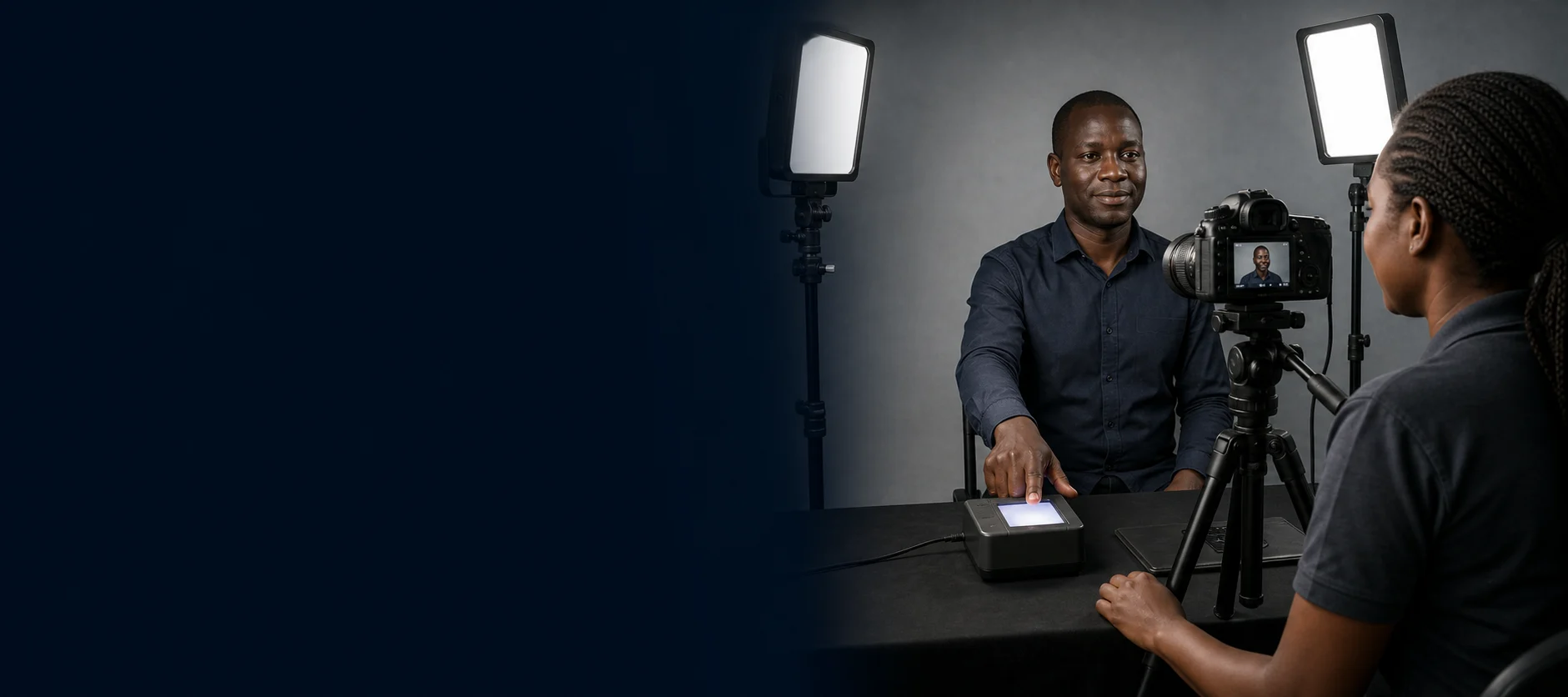
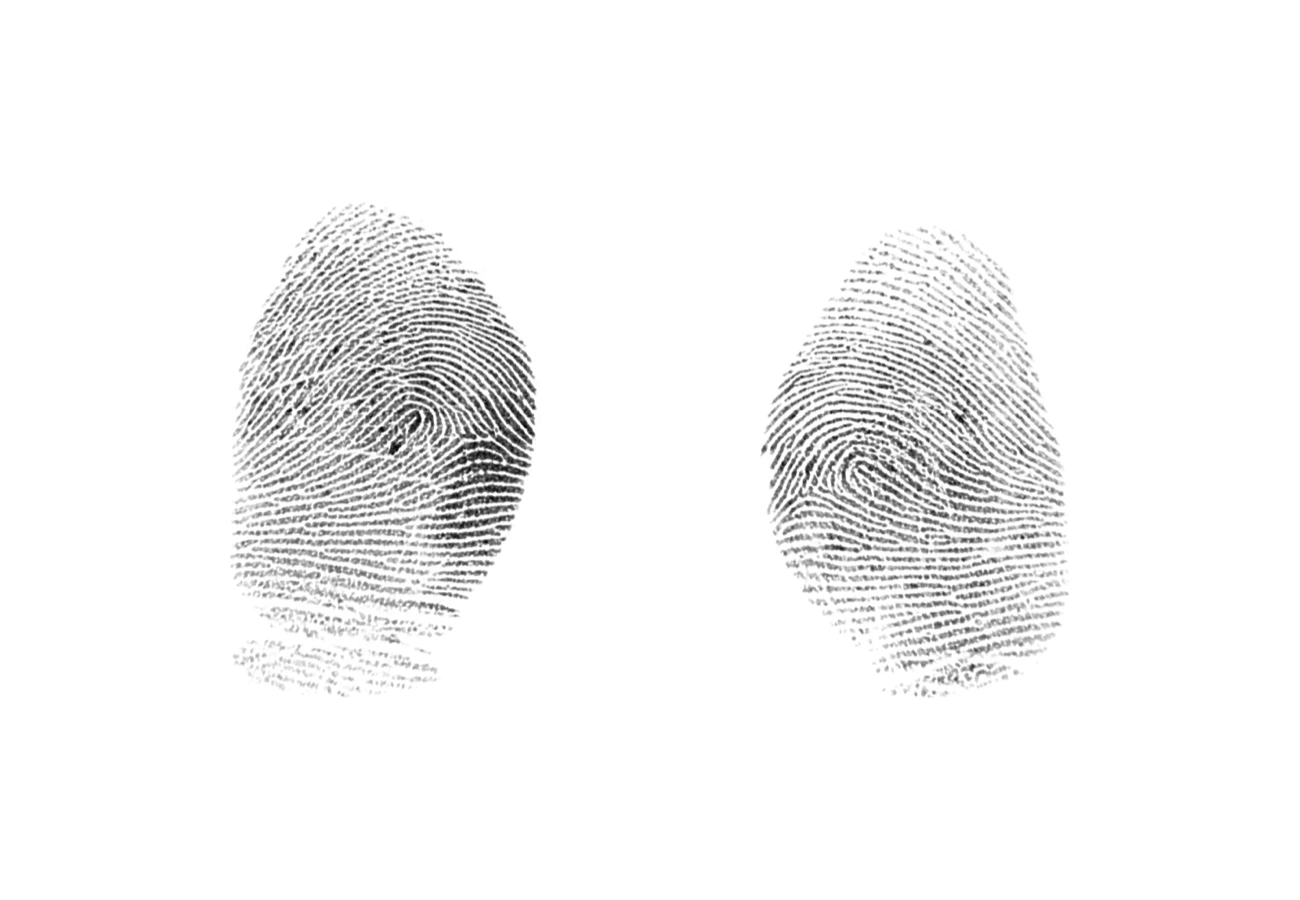
The modality most identity registries are already built on — a mature ecosystem, low-cost sensors, and decades of interoperable standards. In-person capture is robust in ordinary environments: there is no ICAO-style background or lighting requirement. Contactless capture can run on calibrated mobile cameras, but purpose-built high-resolution cameras remain the recommendation for foundational enrolment and for matching against legacy contact-print databases.
Best fit
- Point-of-sale SIM and account verification
- Field enrolment with an established capture ecosystem
- Registries where FAP-rated hardware is already deployed
- Repeat 1:1 verification against a known enrolment
Trade-off: worn, scarred, dry, henna-marked and amputated fingers happen more often than vendor material admits, and quality can decline with manual labour and age. Sensor-based capture usually includes its own presentation-attack controls; contactless capture needs an explicit PAD/liveness evaluation. There is no evidence for a universal 25-year recapture window: NIST found stable operational accuracy to 12 years in its available longitudinal data when samples were good quality.
The only remote-capable modality
Face
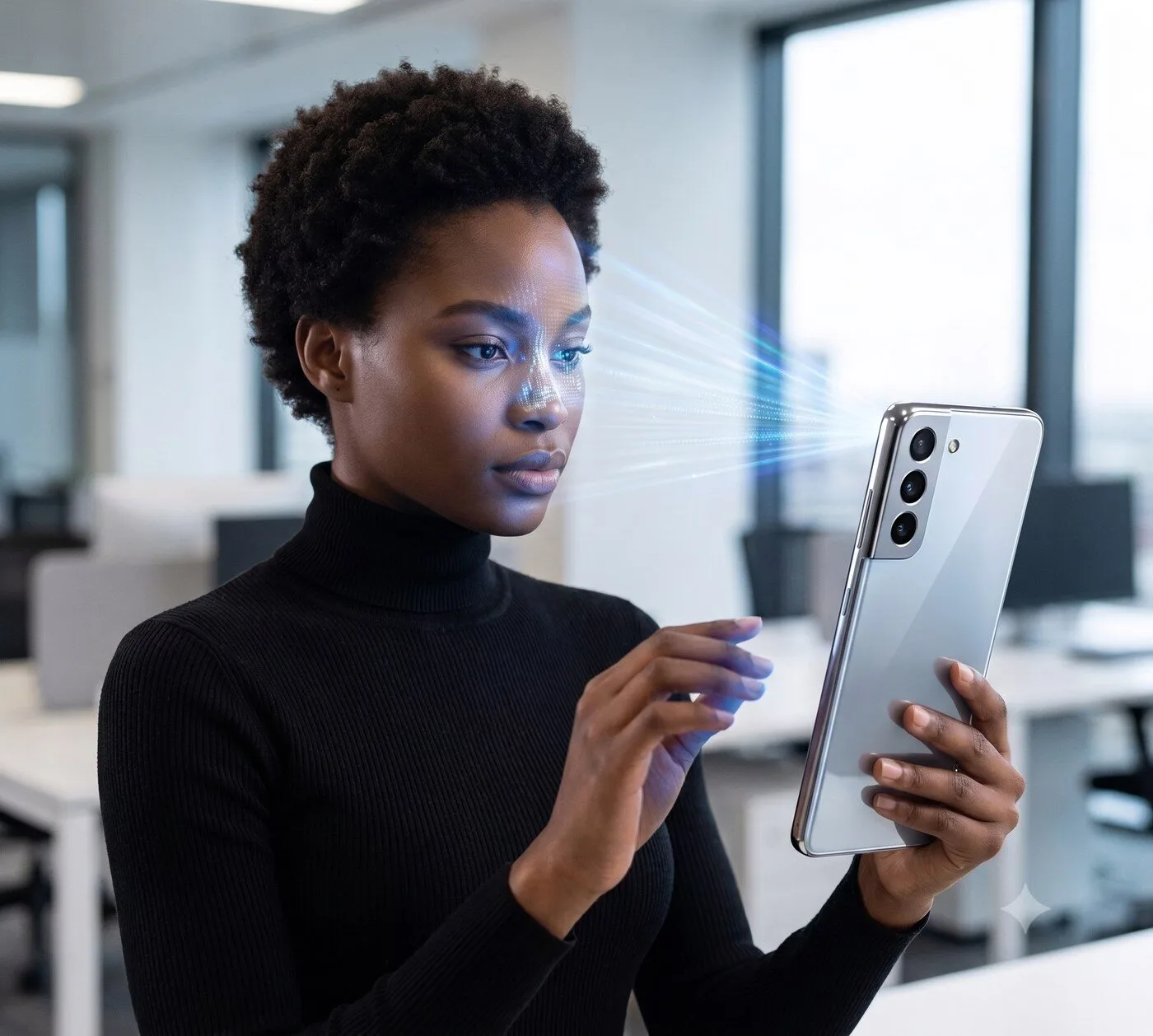
The one modality a subscriber can capture on their own phone, from wherever they are — no dedicated sensor, no agent visit. For ordinary 1:1 biometric comparison, modern software can tolerate a broad range of cameras and environments. For ICAO-quality or foundational enrolment, the capture bar is higher: uniform lighting, a plain background, controlled external light and a quality camera are needed. A 5 MP camera is a practical planning floor; use 8 MP or higher where the portrait will become a long-lived identity record.
Best fit
- Remote onboarding and self-service KYC
- Watchlist and sanctions screening at a distance
- Re-authentication for account recovery and SIM swap
- Any journey where an agent or fixed sensor is not available
Trade-off: face matching alone answers whether two images are the same person — not whether the sample was captured live. Pair it with a liveness algorithm; do not treat the match score as a substitute. Twin separation and any claimed 3D performance uplift must be validated on the chosen capture device and algorithm: there is no general rule that face is equivalent to one fingerprint, or that 3D is “100×” more accurate.

The fastest capture
Iris
A sub-five-second capture, largely insulated from the manual-labour wear that erodes fingerprint quality — but only at a dedicated sensor, with the person physically present. It cannot be captured from a selfie or an existing photo.
Best fit
- High-throughput civil registry and national ID enrolment
- Refugee and displaced-persons registration
- Repeat access control where capture speed matters
- Fusion alongside fingerprint to cover its failure cases
Trade-off: near-infrared capture needs a dedicated sensor — phone cameras filter out the band iris recognition depends on. PAD/liveness is provided through the sensor and algorithm together. Two-eye capture measurably improves accuracy, but by a factor of two to three, not a square.
Where each one breaks
Vendor material tends to lead with accuracy and leave the operating constraints for the small print. Laid out side by side, the constraints are what actually decide which modality fits a given journey.
| Dimension | Fingerprint | Face | Iris |
|---|---|---|---|
| Independent benchmark | NIST PFT III · MINEX III | NIST FRVT | NIST IREX III |
| Requires a dedicated capture device | Recommended for foundational / legacy-compatible capture | No for comparison; yes for controlled ICAO-grade capture | Yes |
| Capturable from an existing photo or document | No | Yes | No |
| Typical capture time | ~50s for an assisted ten-print | Near-instant from a selfie | Under 5 seconds |
| Capture environment | In-person capture is tolerant; quality gating matters more than background or light | Any camera for comparison; uniform light, plain background and blocked external light for ICAO portrait capture | Dedicated near-infrared sensor and cooperative, in-person subject |
| Liveness / PAD control | Usually integrated into the sensor; evaluate separately for contactless workflows | Dedicated liveness algorithm is required alongside matching | Sensor and algorithm PAD controls, tested together |
| Template refresh | No universal interval; NIST data supports stable operation to 12 years with good-quality samples | Policy-driven; refresh sooner for children and after material appearance change | Adult operational studies support long-lived use; re-capture on quality or medical exception |
| Documented population-scale failure mode | Worn, scarred, dry or manual-labour fingers | Vulnerable to spoofing without paired liveness | Requires a cooperative subject at a fixed sensor |
Read the second and third rows together — they are the actual decision. A modality that needs a dedicated device and cannot work from an existing photo is a field or desk-based capture; a modality that needs neither is a remote one. Fingerprint and iris are field modalities. Face is the only remote one.
When multimodal fusion earns its cost.
Capturing two modalities instead of one costs more time at enrolment and more hardware in the field. It is worth it when a single modality's failure case has a real consequence — not as a default.
A national ID or civil registry deduplication programme is the clearest case: the population is large enough that some share will fail to enrol on any one modality, and a missed duplicate carries a real cost. Fusing fingerprint, face and iris with score-level matching covers that failure case — a subject who cannot produce a usable print is still captured on face and iris, and a deduplication search runs across whichever modalities were captured.
For a routine 1:1 point-of-sale verification, none of that applies. A single modality is normally sufficient, and fusion adds cost without a proportional benefit.
Where this runs in practice: Axon's Civil ABIS performs sub-second 1:N matching against registries of 50M+ identities, fusing face, fingerprint and iris at the score level. The COMET-M1 handheld captures fingerprint, face and iris in one device, so field enrolment does not require separate hardware per modality.
Civil ABIS
Which modality for which journey
A starting point, not a rulebook — the right answer still depends on the population, the regulatory context and what hardware is already deployed.
Context matters: where a trusted national identity database exists, captured biometrics can be verified against the foundational record rather than relying solely on one-to-one matching. That changes the best mix of face, contactless fingerprint, channel and dedicated hardware.
Remote onboarding via a banking or telco app
Face is the only universally deployable biometric for self-service onboarding. Where a trusted national identity database exists, contactless fingerprint can provide an additional remote verification factor.
Field enrolment, general population
The optimal balance of accuracy, usability and cost. Contact fingerprint scanners deliver high-quality captures for enrolment or verification against a national identity database.
National ID or civil registry deduplication
Face and fingerprint are sufficient for most national identity programmes. Add iris for populations above 50 million when reducing false matches is critical.
Refugee and displaced-persons registration
Robust identity capture at significantly lower cost than iris-only deployments, while remaining practical in challenging field environments.
Border control and watchlist screening
Face enables rapid screening while fingerprint provides strong identity verification. Iris is an optional enhancement where throughput and scale justify the investment.
SIM registration at point of sale
Face is the preferred primary biometric for subscriber registration. A single fingerprint adds an inexpensive layer of assurance and supports verification against a foundational national identity database where available.
Frequently asked questions
Which biometric modality is the most accurate?
Why not use fingerprint for every programme — it is the cheapest and most established?
Can face recognition work without dedicated hardware?
Why can’t iris be captured from a selfie or an existing photo?
Does capturing both eyes double iris accuracy?
When is multimodal fusion worth the added cost?
Do fingerprint, face and iris degrade at the same rate over a person’s lifetime?
Should a programme enrol everyone from age 16?
Does 3D face matching solve the twin problem or make face 100 times more accurate?
Further reading
Designing an enrolment programme?
We'll help you pick the modality — or the mix.
Tell us the population, the journey and the stakes, and we will map them to the right modality, hardware and fusion strategy.
Talk to Our Team