
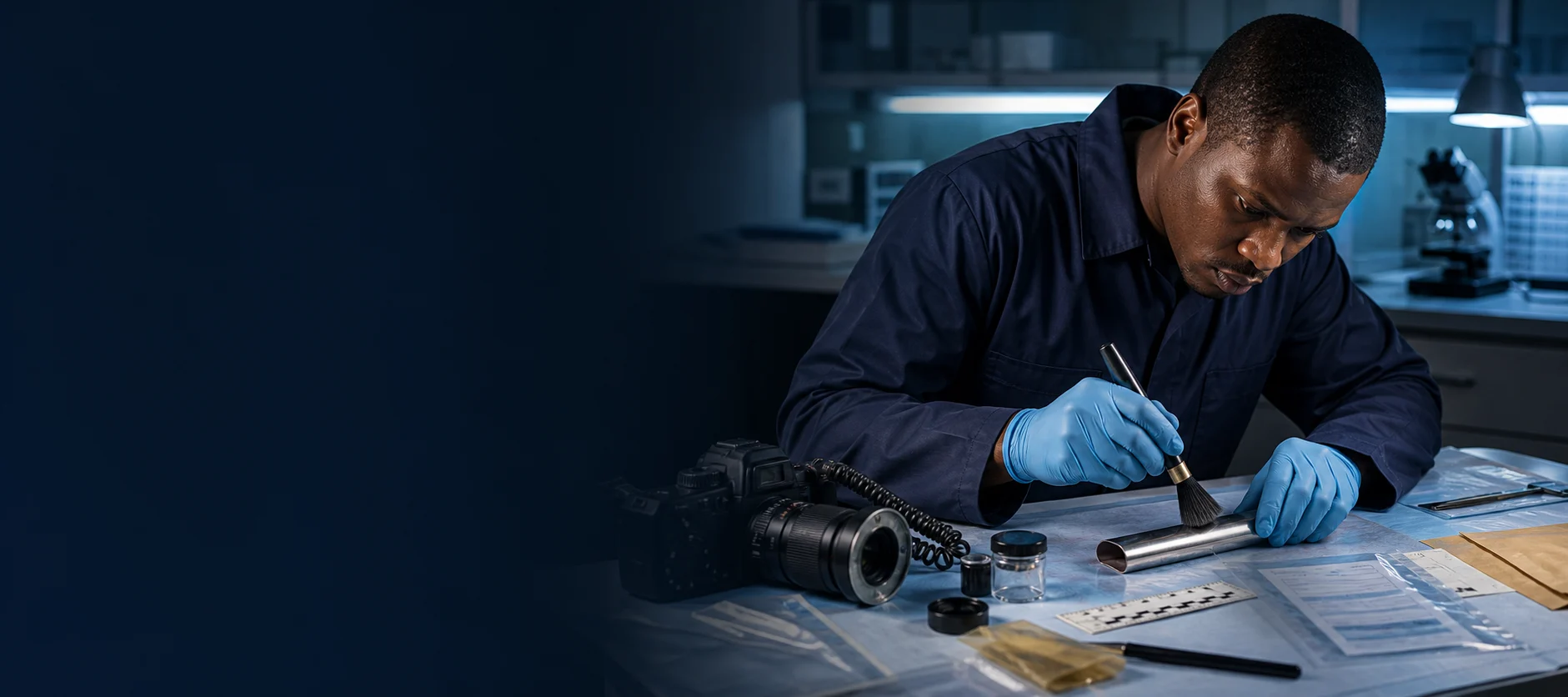
Forensic technician collecting latent fingerprint evidence in a laboratory

Technology · Forensic identification

Criminal ABIS, from the scene to the courtroom.

Booking and tenprint enrolment, latent examination, palm and face-in-video search, case management and court-ready adjudication — one system, built on a matching engine that ranks among the top performers in the NIST benchmark programmes.

NIST-benchmarked matching

MINEX · ELFT · PFT · IREX · FRVT

One unified suspect profile

Finger · palm · latent · face · iris · SMT · DNA

The short answer

A criminal ABIS is the chain that carries a biometric from the booking room to the court exhibit — and keeps it admissible the whole way.

Civil ABIS answers one question at scale: has this person already registered? Criminal work is different. Evidence arrives degraded, partial and out of order — a latent lifted from a door handle, a face in twelve seconds of CCTV, a palm edge on a windowsill — and every result has to be reconstructable months later in front of a court.

Axon deploys, integrates and supports a complete criminal identification system: guided booking and enrolment, a forensic examiner's bench for latent work, multi-modal search, case management, field identification and court exhibit generation. The underlying matching engine is independently benchmarked; the deployment, the data migration, the training and the lifetime support are ours.

Suspect bookingLatent examinationPalmprintFace-in-videoCase managementCourt exhibits

01 · Booking & enrolment

Every suspect, one searchable identity.

A guided capture workflow that turns a booking into a complete, quality-checked profile — not a folder of loose images to be sorted out later.

Guided step-by-step booking

A structured capture workflow an operator can be trained on in a day, rather than a screen that assumes forensic experience.

Browser or Android enrolment

Runs in a web browser at the booking desk, or on an Android device for a decentralised station.

Real-time quality evaluation

ICAO for face capture and NFIQ for fingerprint quality — a poor capture is flagged while the subject is still in the room, not discovered during a later search.

Legacy card digitisation

Existing paper fingerprint cards, including FD-258 format, are digitised and quality-checked into the register rather than bulk-scanned and hoped for.

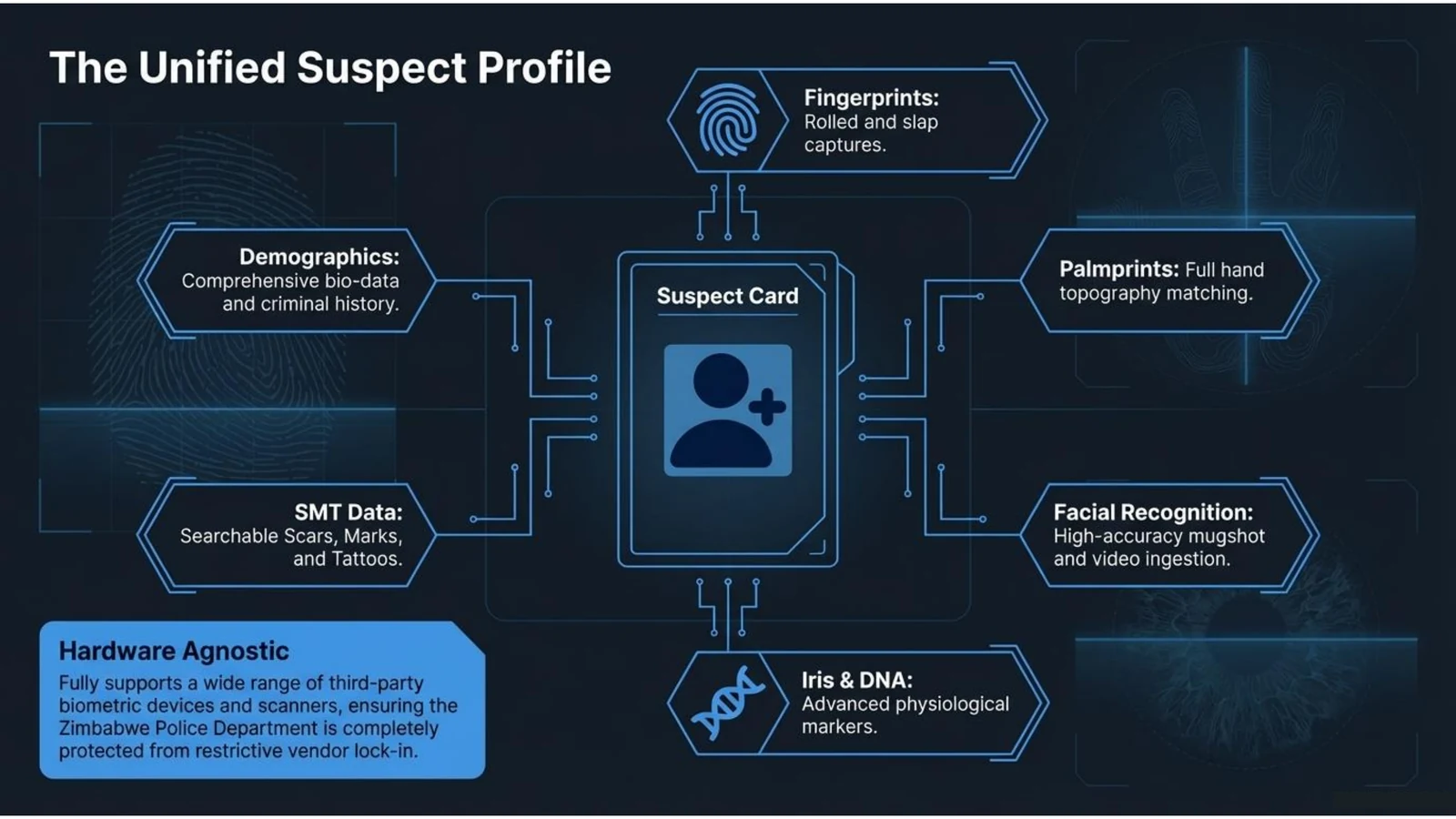
The unified suspect profile

Rolled & flat fingerprintsPalmprintsFaceIrisSMT — scars, marks, tattoosDemographic dataDNA reference
Diagram of a unified suspect profile spanning fingerprint, palmprint, demographic, SMT, facial and iris/DNA data

One record, every modality — the unified suspect profile

02 · Latent examination

A partial ridge is still an identification.

Latent work is image work before it is search work. The examiner's bench gives the tools that enhancement and comparison depend on — and records every step.

Prepare the evidence

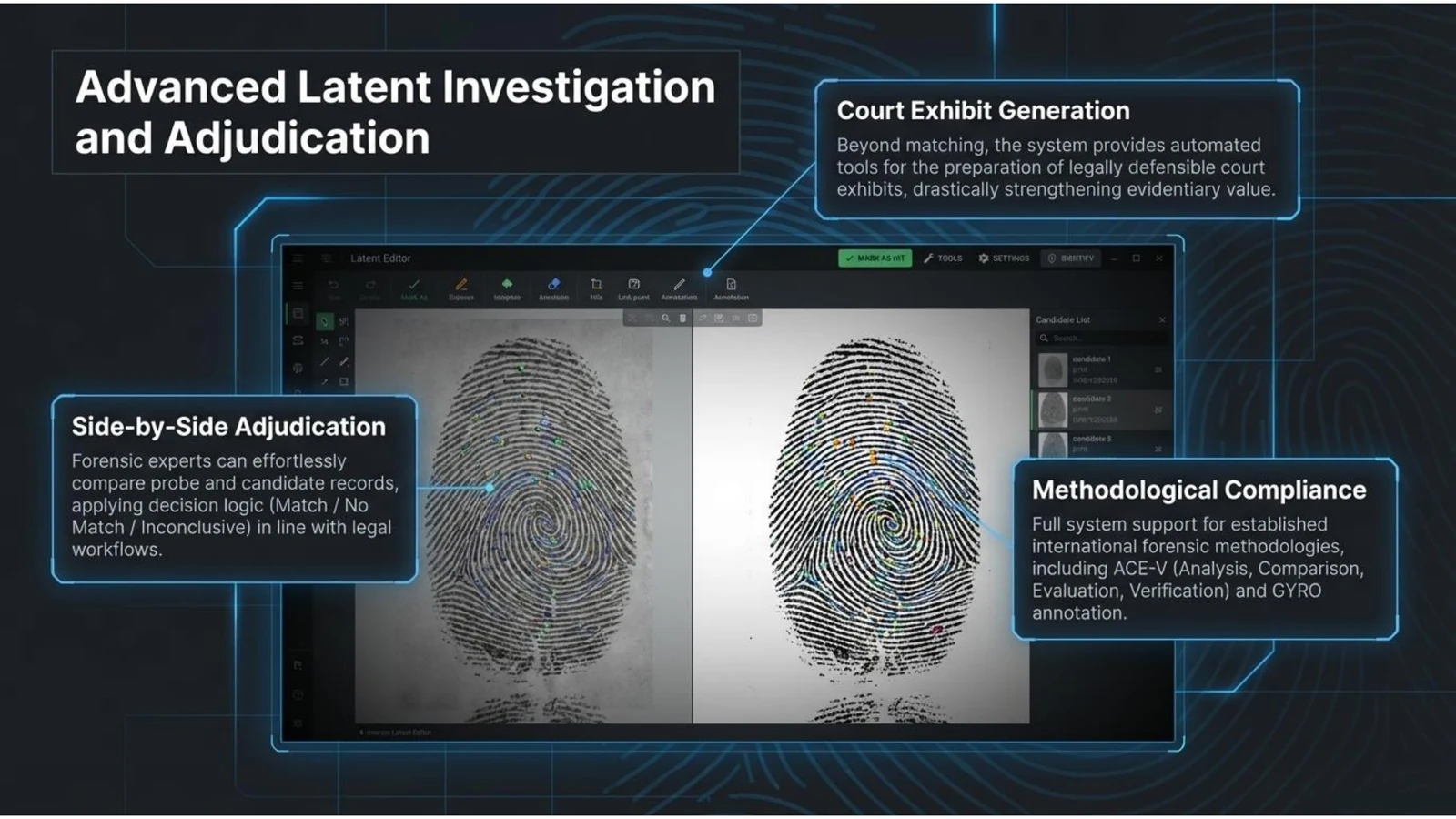
Latent print editor

A latent arrives as a photograph of a surface, not as a usable biometric. The editor turns one into the other, while keeping the original alongside every worked version.

Normalisation

DPI, perspective, flip, rotate, crop

Enhancement

Contrast, gamma, histogram, colour temp, invert

Annotation

Significant marks flagged visually

Minutiae

Detected automatically, adjusted by hand

Best fit

  • Scene photography and lifted latents
  • Poor-contrast surfaces and oblique lighting
  • Partial and overlapping impressions
  • Digitised legacy card records

Every adjustment is a step an examiner can be asked to justify later — the editor keeps the original next to the worked image, not in place of it.
Run the comparison

Search & candidate review

Four latent search modes and adjustable parameters, returning a ranked candidate list rather than a verdict. The examiner decides; the system evidences.

Modes

Latent-to-plain, -rolled, -palm, -latent

Parameters

Speed, threshold, rotation, candidate count

Output

Ranked list by identification score

Review

Side-by-side probe and candidate

Best fit

  • Cold searches against the criminal register
  • Case-to-case latent linking
  • Palm searches from a single edge impression
  • Visual audit for expert adjudication

The system never declares an identification on its own. A ranked candidate is a lead until an examiner adjudicates it.

Latent print editor showing ridge enhancement and minutiae marking on a fingerprint

Ridge enhancement and minutiae adjustment on a latent impression

Adjudication & disclosure

An ABIS that cannot show its working is an investigative tool, not an evidential one.

Match

The examiner confirms the candidate against the probe, with the full comparison retained.

No Match

The candidate is excluded — and the exclusion is recorded, not merely dropped.

Inconclusive

Insufficient detail to decide, recorded as its own outcome rather than forced into one of the other two.

Side-by-side comparison

Probe and candidate shown together with every annotation preserved on both.

Visual audit

ACE-V & GYRO support

The methodology an examiner already testifies to, supported in the workflow rather than worked around.

Methodology

Automated court exhibits

The exhibit is generated from the comparison itself, so what the court sees is what the examiner saw.

Disclosure

Action tracking

Audit logs record who searched, who adjudicated, which parameters were used, and when.

Chain of custody

Decision logic, retention rules and the case file structure are configured to the agency's own legal framework — the workflow follows the statute, not the software.

03 · Video & case intelligence

Evidence that connects itself.

Face-in-video turns hours of surveillance footage into an identification lead. Case management turns scattered evidence into a case that reveals its own connections.

Face-in-video identification

Investigation video is ingested, managed and processed against enrolled identities — at up to 25× the video's real-time length, so an overnight camera dump becomes a morning's work rather than a week's. Annotation runs automatically, and the investigator can add or correct marks by hand.

Up to 25× faster than real time

Automatic + manual annotation

Matched against enrolled identities

Evidence, grouped by case

Biometric and non-biometric evidence — SMT, face and body characteristics, related images — held against the same case file, structured to the agency's own legal framework.

Full identification history

Upload metadata, search history and every hit attached to the case, so a review months later does not start from a blank page.

Connections between cases

Shared evidence across unresolved cases is surfaced automatically — a link an individual investigator would otherwise have to notice by memory.

04 · Field identification

Identification at the roadside.

A single portable device replaces three separate peripheral scanners — collecting fingerprint, face and document data, then searching it against the register from wherever the officer is standing.

Android & Windows

The same field workflow on the platforms agencies already procure.

REST to the matcher

Captured data is transferred directly to the matching engine for identification.

Online or offline

Operates against local storage when there is no connectivity, and syncs once there is.

Encrypted at rest

Locally held data stays encrypted, protected from unauthorised access if the device is lost.

Runs on Axon's own hardware, too

Field identification is not tied to a single device family. The COMET range — purpose-built for fingerprint, face and document capture in the field — runs the same enrolment and search workflow as any supported Android terminal.

Explore the COMET range

05 · Platform & standards

A browser, a field device, and no lock-in.

Analysis, identification, case management, monitoring and administration all run in a browser. Sized from a single department to a central criminal register.

Browser-based throughout

Analysis, identification, case management, system monitoring and administration in one web interface — no bespoke workstation build per examiner.

Field identification

One portable device replaces three separate peripheral scanners. Android and Windows, talking to the matching engine over a REST interface.

ANSI/NIST-ITL exchange

Standards-based transaction formats for inter-agency and cross-border sharing, so records leave and arrive without bespoke translation.

Hardware-agnostic

A wide range of biometric scanners and capture devices are supported. Peripheral choice stays a procurement decision, not a lock-in.

Configurable by design

Rules, thresholds, enrolment options, workflows, roles and users are configuration — not custom development for every agency.

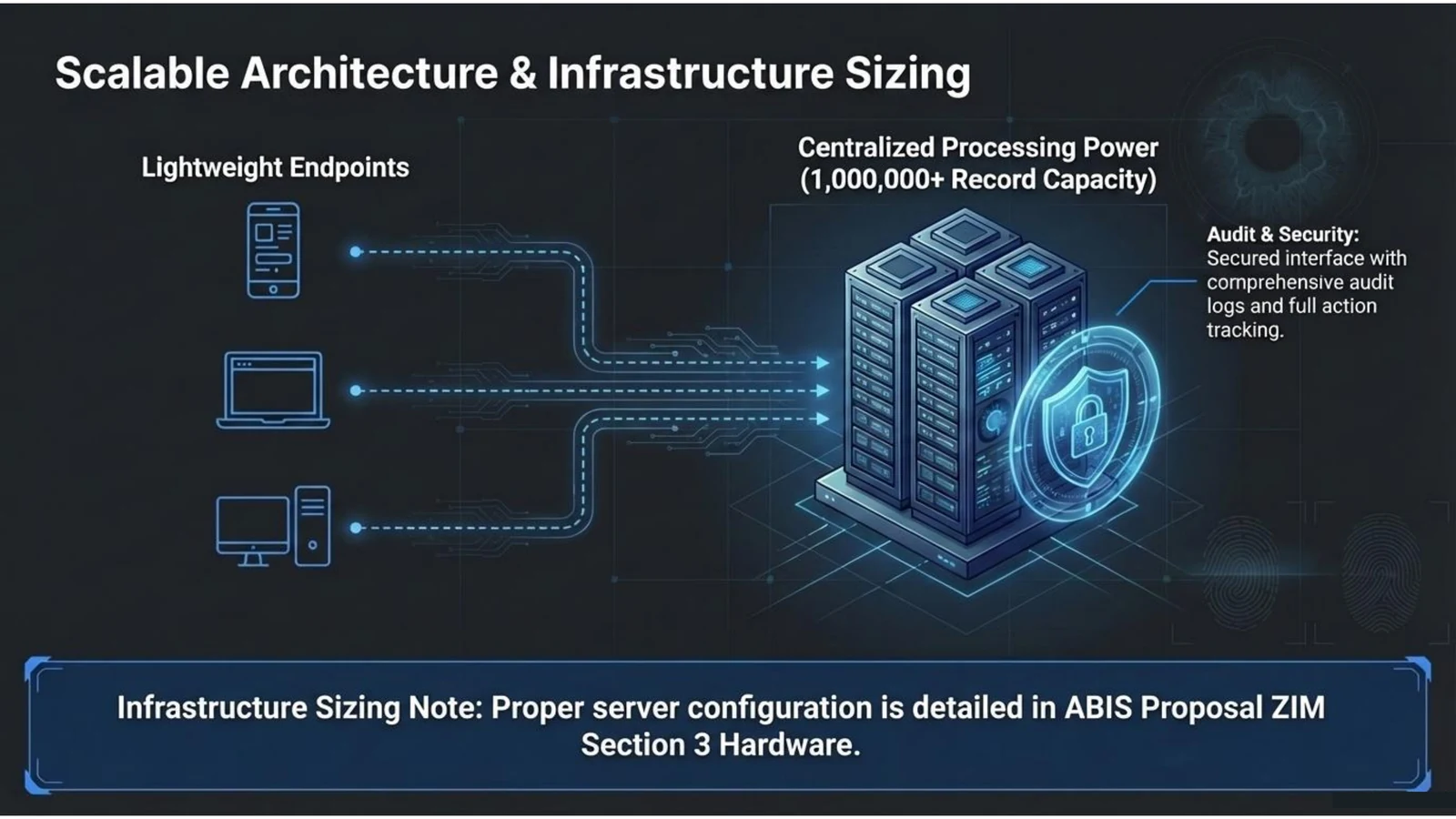
Audited throughout

Every search, review and administrative action is logged, so activity can be reconstructed rather than taken on trust.

Deployment architecture diagram showing lightweight endpoints connecting to centralised processing power

Deployment architecture — endpoints, centralised processing and audit

What modernising actually changes

Data storage & integrity

Paper-based cards, physical degradation, siloed archives.

Fully digitised, deduplicated backfile with disaster recovery.

Latent matching speed

Manual sorting by examiners, taking hours or days, with real risk of error.

Automated, sub-second multimodal matching across the register.

Case intelligence

Isolated evidence files, requiring manual cross-referencing between them.

Interconnected case management revealing hidden links between scenes.

Enrolment flexibility

Stationary ink-and-roll capture at specific stations only.

Live digital capture via secure browsers or Android devices in the field.

06 · What Axon delivers

The software is the easy part.

The system is only useful once the infrastructure is in, the paper cards are digitised, the examiners are trained and someone answers the phone. That is the part Axon owns.

01

Discovery & Architecture

Legal framework, evidence volumes, existing records and a site survey — before anything is specified.

02

Installation & Configuration

Local infrastructure provisioned, secure installation, rules and thresholds configured to the agency's workflow.

03

Migration & Digitisation

Legacy records ingested, paper fingerprint cards digitised and quality-checked into the register.

04

Go-Live & Handover

Operator and forensic-expert training, supervised live running, then handover with support in place.

Infrastructure & installation

Local provisioning, hardening and secure installation, delivered as a project rather than a download.

Capacity building

Specialist training for operators and forensic experts, so the agency runs the system rather than depending on us to run it.

Lifetime maintenance & support

Ongoing production support and maintenance for the life of the deployment.

Start with the mandate

Let us scope the system against your caseload.

We work from evidence volumes, existing record holdings, the legal framework you operate under and the state of your legacy archives — then specify the deployment around them.

Speak With Our Law Enforcement Team

Common questions

Criminal ABIS, without the fog.

Clear answers for investigative, forensic and procurement teams.

What is the difference between a civil ABIS and a criminal ABIS?+

A civil ABIS is optimised for one question at population scale: has this person already enrolled? A criminal ABIS has to work from degraded, partial and unattributed evidence — latent prints, palm edges, a face in surveillance video — and carry each result through examiner adjudication to a disclosable court exhibit. The matching is related; the workflow, the evidence handling and the audit requirements are not.

Which biometric modalities does the system support?+

Rolled and flat fingerprints, latent prints, palmprints, face, iris, and scars, marks and tattoos, with demographic data and DNA references held against the same suspect profile. Fingerprint, latent, face and iris matching are all covered by independent NIST benchmark programmes — MINEX, ELFT, PFT and IREX among them.

Does the system decide whether a latent print is a match?+

No. A latent search returns a ranked candidate list scored by the matching engine. A qualified examiner adjudicates using the side-by-side comparison tool and records Match, No Match or Inconclusive. ACE-V and GYRO methodology are supported in the workflow, and the comparison behind the decision is retained for disclosure.

Can it exchange data with other agencies or across borders?+

Yes. Data exchange is ANSI/NIST-ITL standards-based, so transactions can be shared with partner agencies and international bodies without a bespoke translation layer at each end.

We hold decades of paper fingerprint cards. Can those be brought in?+

Yes. Legacy paper fingerprint cards, including FD-258 format, are digitised and ingested into the register as a defined phase of the delivery methodology — with quality checking, not bulk scanning, because a poorly digitised card is worse than no record at all.

Are we locked into particular scanners or hardware?+

No. The platform is hardware-agnostic and supports a wide range of biometric capture devices, and field identification runs on standard Android and Windows devices against a REST interface. Peripheral choice stays a procurement decision.

What does Axon deliver, and what does the platform deliver?+

Axon delivers the deployment: local infrastructure and secure installation, end-to-end project management, migration and digitisation of legacy records, specialist training for operators and forensic experts, and ongoing production support. The identification platform itself is an established, independently benchmarked biometric system that we integrate, configure and support — we do not represent its matching algorithms as our own.