Is iris recognition the same as retina scanning?+
No — they are different structures, imaged with different optics. The iris is the coloured ring at the front of the eye, captured from a short distance with a camera-style sensor. The retina is at the back of the eye and needs a close-range interior scan — the technology retina scanning has a reputation for being invasive that iris recognition does not share, because the two are frequently and incorrectly conflated.
Why can't a phone camera capture an iris? Doesn't every biometric work remotely now?+
Iris capture needs active near-infrared illumination, conventionally in the 700–900 nanometre band, because melanin absorbs visible light and darker irides — the majority in many of the populations Axon serves — show little usable texture outside the infrared. Consumer phone cameras carry infrared-blocking filters, so a stock smartphone cannot enrol an iris, and an ordinary visible-light photograph is not a usable enrolment source. That is why iris, unlike 2D face matching, is not a remote-onboarding tool — it requires the person at a dedicated sensor.
Does capturing both eyes double the accuracy?+
It's a common claim, and NIST tested it directly: it does not hold. Because image-quality issues — off-axis gaze, pupil dilation, cataracts — tend to affect both eyes together rather than independently, capturing two irides reduces the false-negative identification rate by a factor of roughly two to three, not by squaring it, and fusing both eyes typically increases the false-positive rate as well. Binocular capture is still the right default for foundational enrolment: it is a real, measured accuracy gain, delivered in a single presentation.
Is iris recognition spoof-proof?+
No biometric is. The credible attack vectors for iris are printed iris images, patterned contact lenses and prosthetic eyes; the countermeasure is presentation attack detection, tested under the ISO/IEC 30107 series. Independent testing shows PAD is effective against known, expected attack types, but the international LivDet-Iris competition has found that even leading algorithms accept a majority of presentations from a broad, partly unfamiliar set of attack instruments. For high-consequence transactions, we specify PAD tested to ISO/IEC 30107-3 and recommend supervision or a second modality rather than relying on iris PAD alone.
How stable is an iris over a lifetime?+
The iris forms in gestation and isn't subject to the wear that changes friction-ridge skin. NIST's longest operational study, using about a decade of border-crossing data, found no accuracy loss attributable to iris ageing over that period. Longer-term claims aren't something recognition data can support yet — no public dataset tracks the same irides across a full lifetime — but over the roughly ten-year horizons that have actually been measured, iris templates hold up well, comfortably longer than most identity documents remain valid.
What standards apply to iris data?+
ISO/IEC 19794-6:2011 specifies the iris image interchange format, and its successor, ISO/IEC 39794-6:2021, is what ICAO Doc 9303 now requires: inspection systems must be able to read it from 1 January 2026, and issuing states must use it from 1 January 2030. ISO/IEC 29794-6 covers how iris image quality is measured. In an ePassport, face is the required biometric and iris is optional — where a state includes it, ICAO requires storing the iris image itself, not just a matching template, specifically so the choice of matching vendor can change without re-enrolling the population.
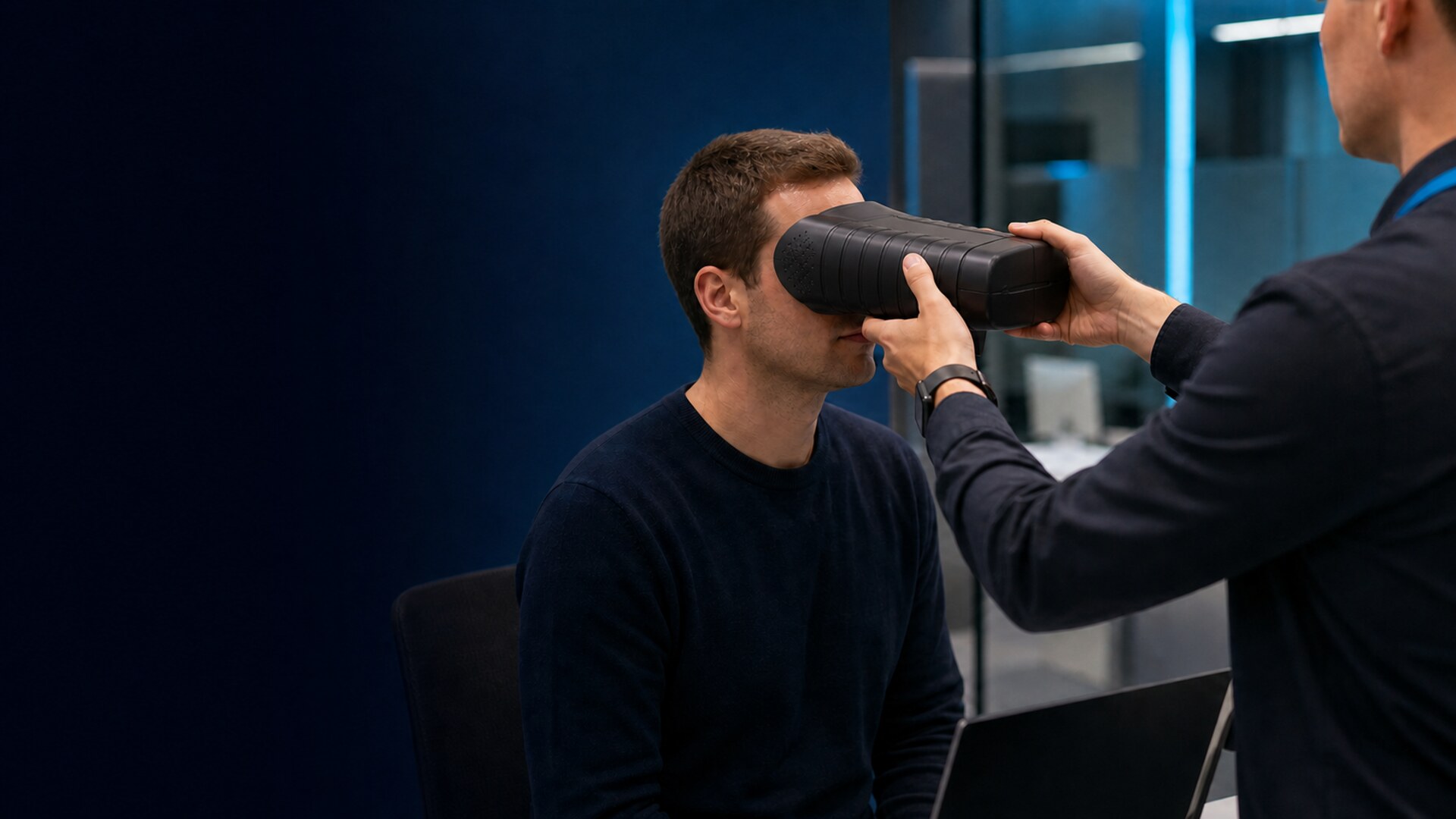
Can the COMET-M1 capture and verify iris?+
Yes — the COMET-M1 captures iris in an easily portable, rugged handheld form factor, as an optional configuration alongside FAP30 fingerprint and 1:1/1:N face matching, so a single ~500 g device can both capture and verify iris in the field. For foundational, one-time national enrolment we recommend specifying a dedicated binocular scanner for the initial capture, then using COMET-M1 for field verification, re-authentication and mobile re-enrolment against that record.